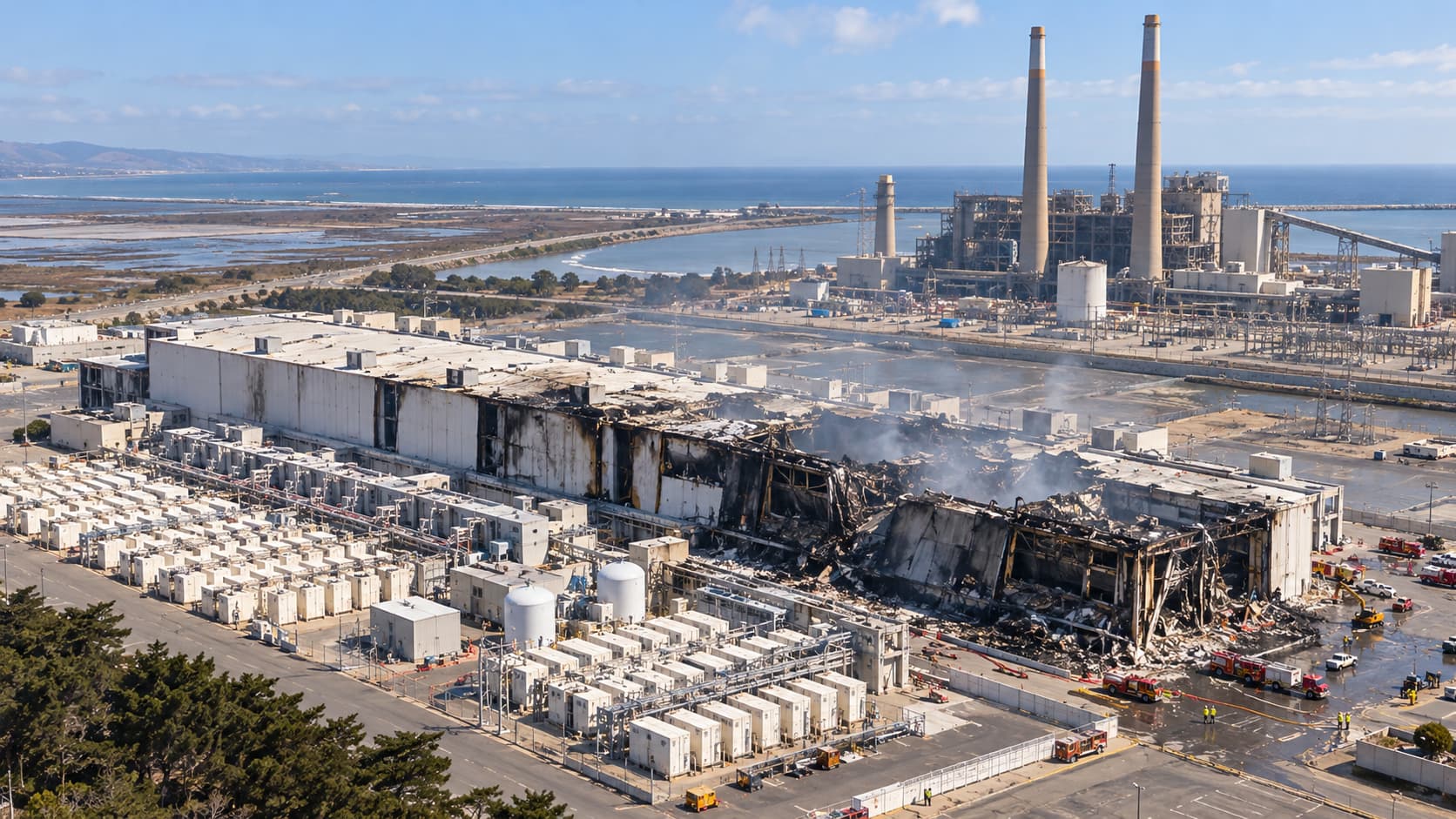
California needs batteries to move solar electricity into the evening, when demand remains high after the sun goes down. But a battery facility must remain safe not only while it operates, but also after equipment fails. That second challenge became impossible to ignore at Moss Landing, where a major fire in January 2025 was followed by another in September 2026. The incidents involved the same damaged building, yet unfolded under different conditions. Together they raise a question for the state’s energy transition: who is responsible for controlling a battery hazard that can persist long after a plant shuts down?
Two Fires, Different Circumstances
On January 16, 2025, a fire broke out inside Vistra’s Moss Landing 300 battery storage facility in Monterey County. The 300-megawatt installation held approximately 100,000 lithium-ion battery modules. According to the US Environmental Protection Agency, about 55% were damaged. The blaze subsided on January 18, but the destruction left a difficult cleanup operation rather than a safe, empty building. Authorities monitored the air for fine particles and hydrogen fluoride, a toxic gas that can be released during battery fires. EPA reported that monitored concentrations did not exceed the relevant health thresholds during its initial response.
On September 18, 2026, fire returned to the north side of that building. This was not another accident during normal grid operations: the system had been out of service since January 2025, and its batteries were no longer connected to the grid. Some intact modules still held a substantial charge, however, and were trapped in areas too dangerous to access during the first cleanup phase. EPA estimated that roughly 1,300 modules burned. Nearby residents received a precautionary shelter-in-place order, the fire subsided that morning, and no injuries were reported. The precise ignition cause remains unknown.
The site already had a troubled record. Vistra’s facility experienced overheating events in September 2021 and February 2022, and a neighboring PG&E battery system had a smaller fire in September 2022. Moss 300 also used nickel manganese cobalt (NMC) cells, a chemistry considered less thermally stable than the lithium iron phosphate (LFP) cells now common in grid storage. Its batteries sat in a large indoor hall inside a former gas-fired power plant, and the facility was designed before California adopted the national fire standard for stationary storage.
Damaged Batteries as a Lasting Hazard
Lithium-ion cells can enter thermal runaway when internal heat generation accelerates beyond the cell’s ability to cool. A faulty cell may release heat and flammable gases, threatening its neighbors. The resulting chain reaction can be difficult to isolate in densely packed storage. Fire protection therefore has two jobs: limiting the initial event and stopping it from spreading to more modules. Neither is straightforward when batteries are enclosed within a heavily damaged building.
The second Moss Landing fire exposed another part of the problem. A module that survives the original fire is not necessarily discharged or stable. EPA said crews had already removed and de-energized about 40,000 accessible intact modules before September’s incident. Others remained behind structural barriers, awaiting removal. Firefighters elected to let the September blaze burn out while monitoring it with drones and thermal imaging. This was a site-specific tactical decision, not a general rule that water should never be used on lithium-ion battery fires. Water can help cool isolated modules when responders judge it safe.
California Tightens Oversight of Operating Facilities
Some safety reforms were already moving through California’s regulatory process before the January 2025 disaster. In March 2025, the California Public Utilities Commission adopted General Order 167-C, expanding maintenance and operational oversight of energy storage systems under its jurisdiction. The changes implemented earlier legislation, including SB 1383 and SB 38, rather than creating every obligation from scratch after Moss Landing. Operators face additional maintenance and operational standards, recordkeeping requirements, and oversight of emergency response and emergency action plans.
Those plans matter because storage emergencies extend beyond the battery racks. Local fire departments need site layouts, contact information and realistic strategies for smoke, fire or damaged equipment. CPUC now verifies that facility owners have filed emergency response plans with local fire authorities and has begun conducting in-person inspections. A technical logbook is less visible than a new suppression system, but it helps inspectors follow maintenance problems and determine whether warning signs were addressed.
Fire Codes and New Permitting Requirements
California also updated its Fire Code, with changes adopted in March 2025 and effective January 1, 2026. The rules incorporate requirements based on the 2023 edition of NFPA 855, the national standard for stationary energy storage installations. Chapter 12 addresses equipment protection, fire detection, separation, ventilation, hazard analysis and large-scale fire testing where required. The provisions do not mean that every existing site must immediately be rebuilt to one new layout; applicability depends on the installation and governing approval requirements.
A second change came through Senate Bill 283, signed in October 2025 and effective January 2026. For covered new project applications, developers must consult local fire authorities about design, risks and emergency planning at least 30 days before submitting an application. The law also establishes pre-operation inspection requirements, with project applicants bearing inspection costs. Certain permitting pathways have their own procedures and deadlines. The central shift is practical: local firefighters are involved before a large installation begins operating, rather than being consulted only after an emergency occurs.
Cleanup and Environmental Monitoring
The EPA’s cleanup agreement with Vistra illustrates why decommissioning deserves the same attention as commissioning. The work includes safely reaching batteries, disconnecting and de-energizing intact modules, shipping material to approved recyclers or disposal facilities, and containing potentially contaminated dust and water. By September 2026, removal crews had reached tens of thousands of intact modules, yet some remained in an unstable structure. The later fire demonstrated that a site’s emergency plan must remain functional throughout demolition and hazardous-material handling.
Air monitoring is another essential safeguard. During the September incident, EPA directed expanded monitoring for substances including carbon monoxide, hydrogen cyanide and volatile organic compounds. The agency reported no hydrogen fluoride detections and no exceedances of its risk-based screening levels for the additional monitored substances. Such measurements provide information about conditions at specific locations and times, rather than a guarantee that every possible exposure has been eliminated. Monitoring must therefore continue as damaged material is handled and transported.
Soil tells a longer story than air. Scientists at San José State University’s Moss Landing Marine Laboratories, who had monitored the nearby Elkhorn Slough Reserve for years, found that surface concentrations of nickel, manganese and cobalt in marsh soils within about two miles of the plant rose by hundreds to a thousand times after the January 2025 fire. The particles matched the cathode material used in NMC batteries. The researchers continue to track whether these metals move into groundwater and the local food web, while Vistra’s own risk report concluded that no further health evaluation was needed, a difference that remains a source of tension with the community.
Lessons for Future Storage Projects
New storage projects can reduce the consequences of a single failure through modular outdoor enclosures, physical spacing between units, reliable temperature monitoring and tested fire-control designs. California’s State Battery Storage Collaborative reports that much of the state’s utility-scale fleet already uses dispersed outdoor containers. Such configurations can limit the spread of a failure, although no design eliminates the need for maintenance, responder training and carefully planned end-of-life work.
Moss Landing should not be treated as proof that large batteries are incompatible with renewable electricity. It demonstrates that deployment targets and safety planning must advance together. The two fires place responsibility across a facility’s entire life: siting, design, daily operation, shutdown and removal. California’s newer rules strengthen several of those stages. Their real test will be whether inspections, transparent reporting and credible emergency plans prevent a local equipment failure from becoming a prolonged community emergency.